The Canary District
The master-planned neighborhood born from the 2015 Pan Am Games Athletes’ Village.
The Canary District is the part of Toronto that did not exist a decade ago. Master-planned around the 2015 Pan Am Games Athletes’ Village and built between 2014 and 2020, it is the city’s first new neighborhood in a generation — a purpose-designed residential cluster east of the downtown core, anchored by the Cooper Koo Family YMCA, the Distillery District to the north, the Don River trail system to the west, and the East Bayfront waterfront to the south.
I. What Makes the Canary District Distinctive
Three things separate the Canary District from older Toronto neighborhoods.
The first is master-planned coherence. The neighborhood was designed in a single architectural vision — wide sidewalks, traffic-calmed streets, integrated public squares, energy-efficient mid-rise residential buildings, ground-level retail. Walking through it feels closer to a contemporary European urban district than to most Toronto streetscapes that grew piecemeal over a century.
The second is scale. Canary District buildings are mid-rise rather than tower-form — typically eight to fourteen storeys. The result is a streetscape that reads as human-scaled even in a downtown context. Most condo buildings have ground-floor retail, courtyards, and pedestrian connections rather than the residential-only towers of King-Spadina or the Financial District.
The third is recreation infrastructure built into the neighborhood. The Cooper Koo Family YMCA — one of Toronto’s largest — sits at the heart of the district. Corktown Common, a thirty-acre park designed by Michael Van Valkenburgh, anchors the eastern edge. Underpass Park reuses the space beneath the Eastern Avenue overpass as public art and basketball courts. Few Toronto neighborhoods have this density of designed public space within their own footprint.
II. What the Canary District Offers
Specific practical features of this address:
- Cooper Koo Family YMCA — pool, gym, indoor track, full programming. Membership available; many Canary District residents fold this into their daily routine.
- Distillery District — five-minute walk north. Toronto’s preserved 19th-century industrial complex, now restaurants, galleries, and theatres.
- 504 King and 514 Cherry streetcar lines — direct connections to the Financial District, Union Station, and west into Liberty Village.
- Don River trail system — uninterrupted cycling and walking from the Canary District to the lakefront Martin Goodman Trail and north into the Don Valley parks.
- Corktown Common — thirty-acre park with splash pad, off-leash dog area, woodland trails, and event lawns.
- East Bayfront waterfront — twelve-minute walk south. Sugar Beach, the Aitken Place Park, the Sherbourne Common.
- Adjacent districts: Distillery District north, Corktown west, Riverside east, East Bayfront south. The Canary District is the connective tissue between them.
- Modern building stock: in-suite laundry, modern kitchens, energy-efficient construction, full concierge in most buildings.
III. Getting Around the Canary District
The Canary District is a ten-to-fifteen-minute walk from the closest subway stations (King, Queen, or Sherbourne on Line 2). For most furnished-condo guests, the streetcars on King and Cherry — combined with cycling and walking — cover daily movement comfortably.
Union Station is reachable in roughly fifteen minutes via the 504 King streetcar, putting GO regional rail, UP Express to Pearson Airport, and VIA national rail within a single transit step. The Financial District is the same trip in reverse.
For guests with a car, parking is meaningfully more available than in core downtown neighborhoods. Most Canary District condo buildings include parking with furnished unit packages.
IV. Dining, Coffee, and Everyday Life
Canary District dining is split between three nearby clusters: the neighborhood itself, the Distillery District a five-minute walk north, and Corktown to the west.
Inside the district, ground-floor retail includes a few cafés, casual restaurants, a yoga studio, and convenience grocery. Walking five minutes north into the Distillery opens up restaurants like El Catrin, Cluny Bistro, and the Mill Street Brew Pub. Corktown’s main street offers smaller independent operators.
Grocery: a major Loblaws sits at Front and Sherbourne, ten minutes’ walk west. Smaller markets fill in within the neighborhood.
V. What to Expect Inside a Canary District Furnished Condo
Most furnished units in the Canary District fall into a few categories.
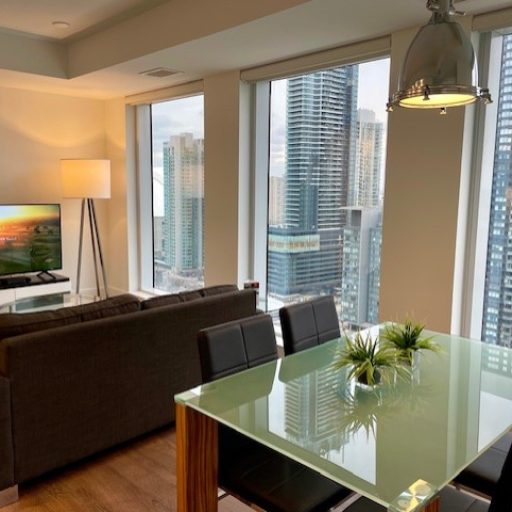
Studios and one-bedroom suites typically run 450–700 square feet, often with floor-to-ceiling windows facing the courtyard, the YMCA, or the lake. Most include in-suite laundry, modern kitchens, and small balconies.
Two-bedroom configurations commonly run 850–1,100 square feet, suitable for parties traveling together or for stays where work-from-home space matters.
Building amenities are unusually strong for the neighborhood’s price point — most newer Canary District buildings include full gyms, party rooms, rooftop spaces, and 24-hour concierge as standard.
VI. Practical Booking Considerations
- Subway distance. 10–15 minute walk to the closest stations. If daily subway access matters, factor this in.
- Parking availability. More accessible than in core downtown; confirm at booking whether it is included or extra.
- Building age. Most stock is 2014–2020. Newer buildings tend to have stronger HVAC, sound insulation, and amenity programming.
- YMCA access. The Cooper Koo YMCA is open to non-members for day passes; many guests on extended stays opt for monthly membership for the duration.
- Don River trail. The trail starts at the western edge of the neighborhood and is one of Toronto’s underused recreational corridors. Worth verifying if cycling is part of your daily plan.
- Distillery District events. Throughout the year — Light Festival in winter, summer concerts, Christmas Market — Distillery foot traffic spills into Canary District. Check event calendars against your stay.
VII. How the Canary District Compares
For thirty-plus-day stays, the Canary District trades different things than its neighbors:
- vs. King West — King West is louder, more central, more dining-dense. Canary District is quieter, more residential, less expensive per square foot.
- vs. Yorkville — Yorkville is luxury-tier, retail-corridor, cultural-institution-adjacent. Canary District is contemporary urban without the luxury overhead.
- vs. Harbourfront — Harbourfront has the lake, Canary District has the design coherence and the YMCA. Both walkable to one another.
- vs. Liberty Village — Liberty Village is on the west side, Canary District on the east. Both mid-rise, both newer stock, both relatively pricing-friendly.
VIII. Is the Canary District Right for You?
The Canary District is the right choice for stays where master-planned coherence, designed public space, daily YMCA access, and a quieter residential feel matter — and where the trade of a ten-minute walk to the subway is acceptable.
It is less ideal for stays that need direct subway access, ultra-luxury finishes, or downtown-core nightlife. For those preferences, Yorkville or King West are stronger fits.
IX. Next Steps
Furnished condominium inventory in the Canary District tightens during summer (Distillery festival season) and during major events at the nearby Lakeshore venues. If you are considering a thirty-plus-day stay, reach out as early as possible with your dates, preferred unit size, parking requirements, and any specific building preferences. Visit the Canary District directory for current properties.
Find your Canary District residence
Begin InquiryCanary District Hub · All Properties
King West · Compare the Neighborhood
Property Directory · All Buildings


